
Quick Summary
SEO for app landing pages needs to balance traditional search visibility with App Store Optimization, since the goal is ultimately to turn discovery into downloads. Effective optimization includes targeting branded, category, and feature-specific keywords, using SoftwareApplication structured data, providing clear crawlable content, improving Core Web Vitals, ensuring proper mobile and deep-linking experiences, and earning relevant backlinks. Consistent messaging across the website and app stores also matters, while clear, authoritative content can increase visibility when users ask AI platforms like ChatGPT and Perplexity for app recommendations.
You built a genuinely good app, launched a landing page, and you’re still watching organic traffic sit flat while competing apps with worse functionality somehow rank above you in search results.
The problem usually isn’t your app. It’s that mobile app landing pages need a fundamentally different SEO approach than typical business or product websites, and most teams apply generic SEO advice that doesn’t account for how these pages actually need to work.
I’ve optimized landing pages for app-based clients, and the strategy differs enough from standard SEO that it deserves its own dedicated approach. Here’s exactly how to do it right.
Why App Landing Pages Need a Different SEO Strategy?
App landing pages serve a unique purpose that most content pages don’t. Their entire job is converting a visitor into a download, not just informing or engaging them.
- The conversion action is singular and specific: unlike a blog post that might lead to newsletter signups, contact forms, or purchases, an app landing page usually has one clear goal: get the app installed.
- You’re often optimizing for two different app stores simultaneously: your landing page SEO needs to work alongside App Store Optimization for both Apple’s App Store and Google Play, which have their own separate ranking systems.
- Page speed matters even more than usual: mobile users researching apps have particularly low patience for slow-loading pages, since they’re often already primed to expect instant results from an app.
Understanding these differences shapes every decision you make in optimizing the page itself.
Keyword Research for App Landing Pages
Standard keyword research applies here, but with an added layer specific to app discovery behavior.
People searching for apps often use different language than they would for a general business search. Someone looking for a budgeting app might search “best budgeting app” or “app to track expenses,” or “hire someone to design and develop an app landing page” phrasing that skews toward comparison and discovery intent.
- Target both branded and category-based searches: your landing page should rank for your app’s actual name, but also for the broader category terms people search when they don’t know your app exists yet.
- Research App Store keyword data too: tools that pull keyword volume from Apple’s App Store and Google Play give you insight into how people actually search once they’re already inside those platforms, which often differs from web search behavior.
- Consider feature-specific long-tail keywords: phrases describing specific functionality your app offers tend to have lower competition and attract highly qualified traffic already looking for that exact capability.
Your landing page content should be built around this research, not generic assumptions about how people find apps.
On-Page SEO Elements Specific to App Landing Pages
Certain on-page elements matter more, or work differently, for app landing pages compared to typical web pages. Other local industries run into the same issues, which is why getting podcast listeners from search is worth comparing.
1. Title Tags and Meta Descriptions
Your title tag should clearly communicate what the app does, not just its name, since many searchers won’t recognize your brand yet. Include your primary category keyword alongside your app name for maximum clarity in search results.
Your meta description has room to include a clear value proposition and, where relevant, mention that it’s available on both iOS and Android, which directly addresses a common searcher question before they even click through.
2. Structured Data for App Pages
Implementing software application schema markup helps search engines understand this page specifically represents an app, which can enable rich results like star ratings, pricing, and download counts to appear directly in search results.
This structured data also plays a role in AI search visibility, since AI platforms pulling information about your app benefit from clearly labeled, structured data rather than having to infer details from unstructured page content.
3. Content That Actually Explains the App
This sounds obvious, but plenty of app landing pages are so focused on flashy design that they fail to clearly explain what the app actually does in plain, crawlable text.
- Lead with the core problem your app solves: before diving into features, clearly state the specific problem or need your app addresses, since this is often exactly what someone’s search query reflects.
- Describe key features in real sentences, not just icons: visual feature grids look nice but often lack the actual text content search engines need to understand and rank your page for relevant terms.
- Include use cases and scenarios: describing specific situations where your app helps naturally incorporates long-tail keywords while genuinely helping potential users understand the value.
Technical SEO Considerations for App Landing Pages
App landing pages often use modern frameworks and heavy visual design, which can create technical SEO problems if not handled carefully.
- Watch for JavaScript rendering issues: many app landing pages are built with frameworks that render content client-side, which can cause search engines to struggle indexing your actual page content if not configured properly.
- Optimize for Core Web Vitals aggressively: app landing pages tend to be image and animation-heavy, which frequently hurts loading speed and interactivity scores unless specifically optimized.
- Implement deep linking correctly: proper deep link setup ensures users get directed to the right app store or, if they already have the app installed, directly into the relevant app screen.
- Set up proper mobile responsiveness: this seems obvious for an app landing page specifically, but inconsistent mobile experiences across different device sizes remain a surprisingly common issue.
Building Authority and Backlinks for App Landing Pages
App landing pages benefit from backlinks the same way any page does, but the sources tend to look different from typical business link building.
App review sites, tech blogs covering new app launches, and industry-specific publications relevant to your app’s category are natural, high-value link targets. Getting featured in “best apps for X” roundup articles provides both direct traffic and strong SEO authority signals.
Digital PR around your app’s launch, updates, or unique features can generate organic coverage and backlinks more naturally than cold outreach alone, especially if there’s a genuinely newsworthy angle to your app or its story.
Optimizing for App Store Visibility Alongside Web SEO
Your landing page SEO shouldn’t exist in isolation from your actual app store presence, since both work toward the same ultimate goal of downloads.
Make sure your landing page and app store listings use consistent messaging, since inconsistency between what someone reads on your website versus what they see in the App Store or Google Play creates hesitation right before the download decision.
Consider linking directly to your app store listings with clear, prominent calls to action, and use App Store Optimization principles like optimized screenshots and compelling descriptions to carry that momentum through to an actual install. If you want more depth, this overview of software application markup is a solid external reference.
Why AI Search Visibility Matters for App Discovery Too?
Increasingly, people ask AI platforms like ChatGPT and Perplexity to recommend apps for specific needs, rather than only searching Google or browsing app stores directly.
If your landing page content is clear, well-structured, and specifically explains what your app does and who it’s for, you significantly improve your chances of being the app an AI platform actually recommends when someone asks a relevant question.
This is exactly why treating your app landing page SEO as part of a broader Search Everywhere Optimization strategy matters. Being discoverable through traditional search, app store search, and AI-driven recommendations all feed the same ultimate goal: more genuinely qualified downloads.
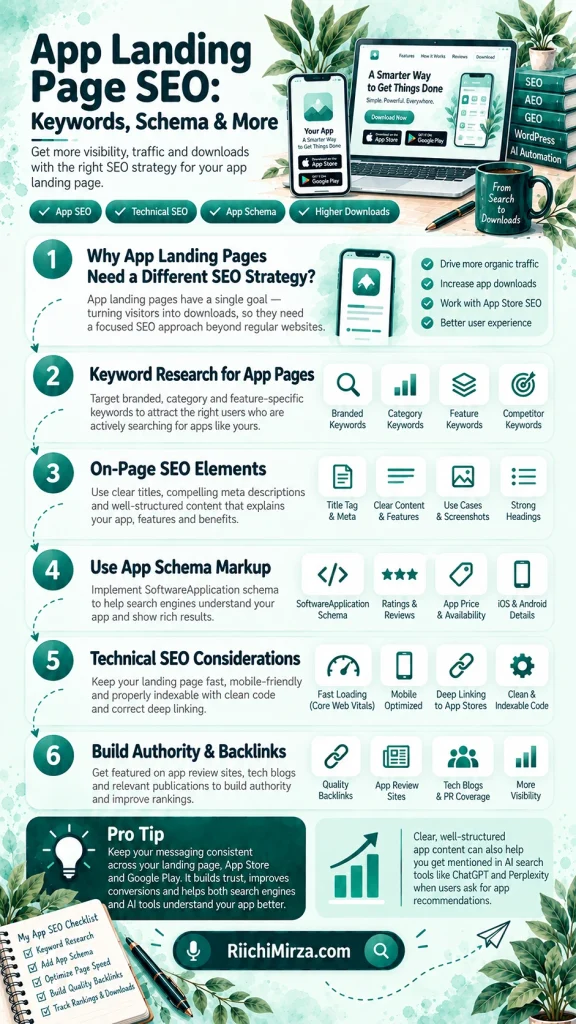
App Page Optimization Infographic
Frequently Asked Questions
Q1. How is SEO different for app landing pages compared to regular websites?
App landing page SEO focuses on a single conversion goal, download intent, and often requires coordinating with App Store Optimization, structured data for software applications, and heavier attention to page speed due to typical design complexity.
Q2. Do app landing pages need App Store Optimization and web SEO separately?
Yes, both matter and work together. App Store Optimization improves visibility within Apple’s App Store and Google Play, while web SEO helps your landing page rank in traditional search engines and AI platforms.
Q3. What schema markup should app landing pages use?
Software application schema is the primary structured data type for app landing pages, helping search engines understand the page represents an app and potentially enabling rich results like ratings and pricing
Q4. Why is page speed especially important for app landing pages?
Mobile users researching apps typically have low patience for slow pages, and slow-loading landing pages built with heavy visuals or animations can significantly hurt both conversion rates and Core Web Vitals scores
Q5. Can an app landing page rank well if it’s built with heavy JavaScript?
Yes, but only if properly configured for server-side rendering or pre-rendering, since client-side JavaScript rendering can cause search engines to struggle indexing the actual page content.
Q6. Should app landing pages target branded or category keywords?
Both. Branded keywords capture people already searching for your specific app by name, while category and feature-based keywords capture people who don’t yet know your app exists but need what it offers.
Q7. How do backlinks help app landing page SEO?
Backlinks from app review sites, tech publications, and industry blogs build authority signals that improve organic rankings, while also often driving direct referral traffic from people actively researching apps.
Q8. Does AI search visibility matter for mobile app discovery?
Increasingly yes, since more people now ask AI platforms like ChatGPT or Perplexity for app recommendations directly, making clear, well-structured landing page content important for being cited in those responses.
Q9. What’s the biggest SEO mistake app landing pages make?
Prioritizing visual design so heavily that the page lacks sufficient crawlable text content actually explaining what the app does, which limits both search engine understanding and keyword relevance
Q10. Should app landing page content be different from the App Store description?
The core value proposition should stay consistent across both, but landing page content can go deeper with use cases, features, and SEO-focused keyword coverage that App Store character limits don’t allow.
Final Words
SEO for app landing pages isn’t just standard website optimization with an app icon slapped on top it requires understanding how people actually search for apps, coordinating with App Store Optimization, and building genuinely informative content that both search engines and real humans can understand. Get the technical foundation right, write content that actually explains your app in plain language, and you’ll start capturing the organic discovery traffic that’s currently going to competitors with weaker apps but stronger SEO fundamentals.



0 Comments